


Page 52 - MFW March 2024
P. 52
The battery on –off switch is fitted under the scale port   airborne, with extra oomph when needed. The Dart Kitten
    storage hatch behind the pilot seat. The pilot sits on the   was  never  intended  to  be  acrobatic  although  she  will
    receiver with the receiver battery tucked up front. Luckily   perform and graceful wing over given encouragement; so
    the  dummy  radiator  could  be  made  from  a  number  of   gentle circuits are the norm; a lovely looking aeroplane full
    shaped thin sheets of lead to aid the correct C of G.     of nostalgia for the gentler things in life and a memorable
                                                              build.
    I obviously choose the colour scheme and registration of
    the surviving Kitten and obtained a CD from ‘Full Size    Since moving to Tauranga two years ago, were I fly electric
    Focus’ no. FF16 from www.traplet.com, giving me details   only at the local Te Puna field with the Western Bay Model
    –insignia etc.                                            Flyers, I had to convert the Dart Kitten to electric. A  1.20
                                                              Rimfire electric motor was installed after modifications to
    Litho plate is used for the cowl and covering for the wing   the firewall and removal of some lead sheets up front. An
    joining which simulates the full size. The wings are slotted   80  amp  speed  controller  is  fitted  and  an  electric  16X8
    into the fuselage via the carbon tubes and held in place by   prop, powered with a 6 cell Lipo battery fitted up front
    a locking sprung wire arrangement held around a large     where the tank used to be. This set up  flies just as well as
    plastic nut head,  all hidden away in the wings. This was   with the ICE set up; albeit shorter flight times. I’ve yet to
    later reinforced with a small O ring under each wing held in   build and fit new dummy engine cylinders!!
    place by screws set into hardwood blocks. The plans did    A few years ago I read in the UK ‘Aeroplane’ magazine
    not give the positive angle for the stabiliser but drawing   that a new owner, Kate Howe had acquired the full size G-
    additional  lines  to  Pars  drawing  measured  about  2   AEXT. I emailed her through the Lancashire Aero club and
    degrees.                                                  sent her a photo of my model, telling her she was not the
                                                              only one to own G-AEXT!
    The covering is solartex throughout giving a strong skin;
    this material is great for covering tight curves.         She replied describing her maiden flight--- ‘It levitates’ she
                                                              said, just like the model I thought. It must be the thick wing
    The maiden flight was on the 13th Feb 2011 at the then     section. Kate kept the plane for about 8 months and then
    Papakura,  Manukau  club  grounds  at  Clevedone  near    sold  it  to  the  Real  Aircraft  Company  at  Breighton
    Auckland.                                                 Aerodrome where it resides.


    Opening the throttle gently, she trundled along and soon
    the tail came up and she then seemed to just gently raise
    –a sort of levitation with slow forward motion. At about 70
    feet she gently dropped the port wing , I gave a correction,
    then she dropped the starboard wing and this continued
    from  side  to  side  until  I  pushed  a  great  deal  of  down
    elevator increasing speed but now she was about 30 feet
    from the ground. After my hands had stopped shaking, a
    gentle turn to the right, gaining a little more height and
    dialling in ALL the down trim, she still would not fly level
    flight  without  lots  of  down  elevator,  but  at  least  the
    swinging from side to side had stopped. I assumed this
    was gentle stalling, but unnerving on the maiden flight.

    I brought her round and landed gently with down stick,
    flaring at the last minute.  Obviously I had got the angle of
    the stabiliser wrong. Back at the shed, I packed 3 mm of
    hardwood under the leading edge, tightened the locking
    nylon stabiliser screw and waited for another suitable day.

    Subsequent flights confirmed the new angle about ok, but
    still needed a little down trim. The take-offs and flights
    were still marginal and the home-made Par Lundquest
    design sprung undercarriage was taking a hammering. I
    decided to fit a laser 100 engine with a 15 X 8 prop and a
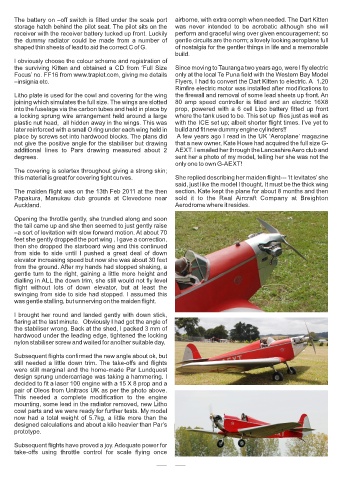
    pair of Oleos from Unitracs UK as per the photo above.
    This  needed  a  complete  modification  to  the  engine
    mounting, some lead in the radiator removed, new Litho
    cowl parts and we were ready for further tests. My model
    now had a total weight of 5.7kg, a little more than the
    designed calculations and about a kilo heavier than Par’s
    prototype.

    Subsequent flights have proved a joy. Adequate power for
    take-offs  using  throttle  control  for  scale  flying  once

                                                            51

