


Page 51 - MFW March 2024
P. 51
fitted with a French Ava 27hp, two-stroke flat four but was
    underpowered.

    A second Kitten was built with various modifications and
    fitted with a more powerful JAP engine and flew later that
    year, registration G-AEXT. The purchase price in 1938
    was 360 pounds. The two aircraft flew again after WWII
    but sadly both crashed killing the pilots but G-AEXT was
    not destroyed.

     A third Kitten was assembled in 1951 from kit parts stored
    in a garage in Loudwater, Buckinghamshire. This machine
    had further minor mods with a registered G-AMJP. It too
    later crashed.

    The only surviving aircraft of this type is G-AEXT and was
    owned by Alan Hartfield many years ago. This was fitted
    with Aeronca  JAP-99  engine  of  35hp.  It  has  had  two
    owners since then I believe but I will come to that later.

    The  model  spans  2440  mm  (96  inches)  with  a  design
    weight of 5.3kg (11.68 lbs). Par Lundquest is renowned for
    designing  light  constructed  models  and  therefore
    suggested  the  model  be  powered  with  a  60  size  four
    stroke.  This  would  give  a  realistic  scale  speed  but  I
    thought  it  may  be  marginal!  Par’s  prototype  model
    weighed 4.7kg!

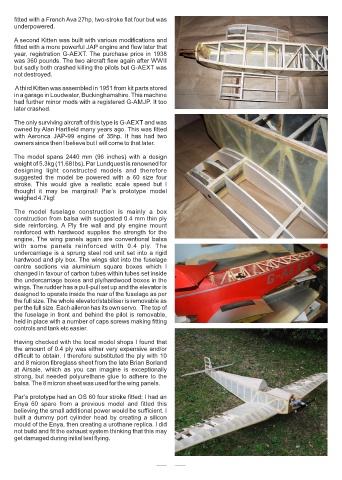
    The  model  fuselage  construction  is  mainly  a  box
    construction from balsa with suggested 0.4 mm thin ply
    side  reinforcing. A  Ply  fire  wall  and  ply  engine  mount
    reinforced  with  hardwood  supplies  the  strength  for  the
    engine. The  wing  panels  again  are  conventional  balsa
    with  some  panels  reinforced  with  0.4  ply.  The
    undercarriage is a sprung steel rod unit set into a rigid
    hardwood and ply box. The wings slot into the fuselage
    centre  sections  via  aluminium  square  boxes  which  I
    changed in favour of carbon tubes within tubes set inside
    the undercarriage boxes and ply/hardwood boxes in the
    wings. The rudder has a pull-pull set up and the elevator is
    designed to operate inside the rear of the fuselage as per
    the full size. The whole elevator/stabiliser is removable as
    per the full size. Each aileron has its own servo.  The top of
    the fuselage in front and behind the pilot is removable,
    held in place with a number of caps screws making fitting
    controls and tank etc easier.

    Having checked with the local model shops I found that
    the amount of 0.4 ply was either very expensive and/or
    difficult to obtain. I therefore substituted the ply with 10
    and 8 micron fibreglass sheet from the late Brian Borland
    at  Airsale,  which  as  you  can  imagine  is  exceptionally
    strong, but needed polyurethane glue to adhere to the
    balsa. The 8 micron sheet was used for the wing panels.


    Par’s prototype had an OS 60 four stroke fitted; I had an
    Enya  60  spare  from  a  previous  model  and  fitted  this
    believing the small additional power would be sufficient. I
    built  a  dummy  port  cylinder  head  by  creating  a  silicon
    mould of the Enya, then creating a urothane replica. I did
    not build and fit the exhaust system thinking that this may
    get damaged during initial test flying.


                                                           50

