


Page 24 - MFWDec 2023
P. 24
Particular attention was focused on:
     Geometrical accuracy, from the Judges view and constant
     flying speed.
     Lines  ~  a  recognizable  length  must  be  flown  between
     manoeuvres and equal length of lines before/after rolls.
     Start and stop must be defined, crisp, and must be seen !
     Roll rates must be constant and roll/loop combinations for
     individual manoeuvres were emphasised and addressed
     in depth.
     Radius ~ must be equal.
     Downgrades for Snaps, Stall turns and Spins.
     Distance, positioning, and size of the manoeuvre within
     the manoeuvring zone were a weighting principle also.


     From the classroom briefing, the Judges Training flights
     were flown on the Official Flightline No 2. There were two
     flightlines ~ both lines had very different treelines and the
     marker poles could not be positioned at 150m out due to
     the farm security fence being within the boundary. Non-
     competitor pilots flew training flights which were scored by
     all judges. On completion of each flight, Peter and the
     judges evaluated the errors in the flight and each judge
     reported and discussed their scores.

     Competition flying commenced on Sunday 20 with four
     Preliminary  rounds  of  P-23  flown;  one  on  each  day
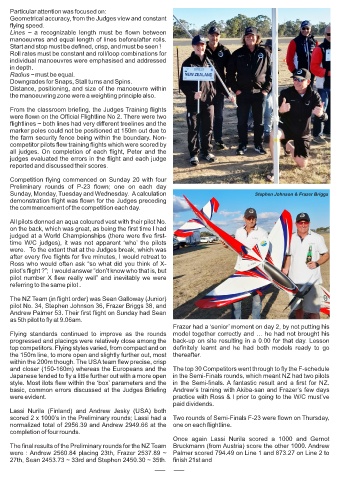
     Sunday, Monday, Tuesday and Wednesday.  A calculation                                 Stephen Johnson & Frazer Briggs
     demonstration flight was flown for the Judges preceding
     the commencement of the competition each day.

     All pilots donned an aqua coloured vest with their pilot No.
     on the back, which was great, as being the first time I had
     judged at a World Championships (there were five first-
     time  W/C  judges),  it  was  not  apparent  ‘who’  the  pilots
     were.  To the extent that at the Judges break, which was
     after every five flights for five minutes, I would retreat to
     Ross who would often ask “so what did you think of X-
     pilot’s flight ?”;  I would answer “don’t know who that is, but
     pilot number X flew really well” and inevitably we were
     referring to the same pilot .

     The NZ Team (in flight order) was Sean Galloway (Junior)
     pilot No. 34, Stephen Johnson 36, Frazer Briggs 38, and
     Andrew Palmer 53. Their first flight on Sunday had Sean
     as 5th pilot to fly at 9.06am.
                                                              Frazer had a ‘senior’ moment on day 2, by not putting his
     Flying  standards  continued  to  improve  as  the  rounds  model together correctly and … he had not brought his
     progressed and placings were relatively close among the  back-up on site resulting in a 0.00 for that day. Lesson
     top competitors. Flying styles varied, from compact and on  definitely  learnt  and  he  had  both  models  ready  to  go
     the 150m line, to more open and slightly further out, most  thereafter.
     within the 200m though. The USA team flew precise, crisp
     and closer (150-160m) whereas the Europeans and the  The top 30 Competitors went through to fly the F-schedule
     Japanese tended to fly a little further out with a more open  in the Semi-Finals rounds, which meant NZ had two pilots
     style. Most ilots flew within the ‘box’ parameters and the  in the Semi-finals. A fantastic result and a first for  NZ.
     basic, common errors discussed at the Judges Briefing  Andrew’s training with Akiba-san and Frazer’s few days
     were evident.                                            practice with Ross & I prior to going to the W/C must’ve
                                                              paid dividends.
     Lassi  Nurila  (Finland)  and  Andrew  Jesky  (USA)  both
     scored 2 x 1000’s in the Preliminary rounds; Lassi had a  Two rounds of Semi-Finals F-23 were flown on Thursday,
     normalized total of 2956.39 and Andrew 2949.66 at the  one on each flightline.
     completion of four rounds.
                                                              Once  again  Lassi  Nurila  scored  a  1000  and  Gernot
     The final results of the Preliminary rounds for the NZ Team  Bruckmann (from Austria) score the other 1000. Andrew
     were : Andrew 2560.84 placing 23th, Frazer 2537.89 ~  Palmer scored 794.49 on Line 1 and 873.27 on Line 2 to
     27th, Sean 2453.73 ~ 33rd and Stephen 2450.30 ~ 35th.   finish 21st and
                                                           23

