


Page 21 - MFWDec 2023
P. 21
it happened and was allowed to stand…so the rules will
    have to be rewritten somehow to correct the anomaly. 47
    fliers out of the entry of 116 fliers made the first flyoff round-
    with a max set at 6 minutes-including Antony Koerbin-who
    hadn’t put a foot wrong all day-but 6 minutes at 8pm at
    night is a bit of a challenge-and only 15 of the 47 made it
    through to the second flyoff round-and Antony had to be
    content with a very creditable 30th place

    F1B day (16 Aug) saw warmer sunnier weather than F1A
    day-though thermal activity was busy, they were by and
    large fairly small-with models travelling 2km or so if high,
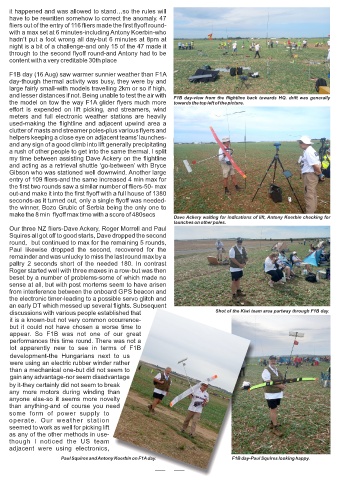
    and lesser distances if not. Being unable to test the air with   F1B day-view from the flightline back towards  HQ. drift was generally
    the model on tow the way F1A glider flyers much more       towards the top left of the picture.
    effort  is  expended  on  lift  picking,  and  streamers,  wind
    meters  and  full  electronic  weather  stations  are  heavily
    used-making  the  flightline  and  adjacent  upwind  area  a
    clutter of masts and streamer poles-plus various flyers and
    helpers keeping a close eye on adjacent teams’ launches-
    and any sign of a good climb into lift generally precipitating
    a rush of other people to get into the same thermal. I split
    my time between assisting Dave Ackery on the flightline
    and acting as a retrieval shuttle ‘go-between’ with Bryce
    Gibson who was stationed well downwind. Another large
    entry of 109 fliers-and the same increased 4 min max for
    the first two rounds saw a similar number of fliers-50- max
    out-and make it into the first flyoff with a full house of 1380
    seconds-as it turned out, only a single flyoff was needed-
    the winner, Bozo Grubic of Serbia being the only one to
    make the 8 min  flyoff max time with a score of 480secs     Dave Ackery waiting for indications of lift, Antony Koerbin checking for
                                                              launches on other poles.
    Our three NZ fliers-Dave Ackery, Roger Morrell and Paul
    Squires all got off to good starts, Dave dropped the second
    round,  but continued to max for the remaining 5 rounds,
    Paul  likewise  dropped  the  second,  recovered  for  the
    remainder and was unlucky to miss the last round max by a
    paltry  2  seconds  short  of  the  needed  180.  In  contrast
    Roger started well with three maxes in a row-but was then
    beset by a number of problems-some of which made no
    sense at all, but with post mortems seem to have arisen
    from interference between the onboard GPS beacon and
    the electronic timer-leading to a possible servo glitch and
    an early DT which messed up several flights. Subsequent
    discussions with various people established that                         Shot of the Kiwi team area partway through F1B day.
    it is a known-but not very common occurrence-
    but  it  could  not  have  chosen  a  worse  time  to
    appear.  So  F1B  was  not  one  of  our  great
    performances this time round. There was not a
    lot  apparently  new  to  see  in  terms  of  F1B
    development-the  Hungarians  next  to  us
    were using an electric rubber winder rather
    than a mechanical one-but did not seem to
    gain any advantage-nor seem disadvantage
    by it-they certainly did not seem to break
    any  more  motors  during  winding  than
    anyone  else-so  it  seems  more  novelty
    than  anything-and  of  course  you  need
    some  form  of  power  supply  to
    operate.  Our  weather  station
    seemed to work as well for picking lift
    as any of the other methods in use-
    though  I  noticed  the  US  team
    adjacent  were  using  electronics,
                      Paul Squires and Antony Koerbin on F1A day.                 F1B day-Paul Squires looking happy.
                                                           20

