


Page 15 - MFW Dec 2024
P. 15
gear but replaced the original air-shock units with simple   This time I cut a slot in the leading edge with a bench saw
    torsion bar springs. For the front wheel I wound a spring  and  glued  in  a  flat  aluminium  extrusion  to  achieve  the
    similar the donor Bensen, but lighter. I used the original  correct c-of-g position. I printed new sanding blocks and
    wheels which were slightly large but gave the model a  used only one guide rail. I screwed both blades (still both
    more modern, robust, bush-plane look. They and the very  part of the same piece of balsa) to the table and roughed
    effective suspension would hopefully prove ideal for the  them out with a plane. It took 30 minutes of sanding to get
    Club’s grass strip.                                       the  tops  accurately  shaped.  I  printed  supports  that
                                                              matched the shape of the top, turned the blades over and
    Power                                                     screwed them onto the supports so they were in exactly
    All  my  models  are  electric-powered  and  the  gyro  was
    always going to be the same. I chose a 4250 800kV motor
    because I happened to have one spare and a 15x4” prop
    because  I  had  some  I’d  ordered  clockwise  by  mistake
    (one  of  the  joys  of  shopping  online…!).  Going  electric
    meant  finding  somewhere  for  the  battery.  Fortunately
    most  gyros  use  the  pilot’s  seat  as  a  fuel  tank,  the
    Dominator being no exception, so I managed to keep the
    seat  looking  reasonably  “scale”  with  room  to
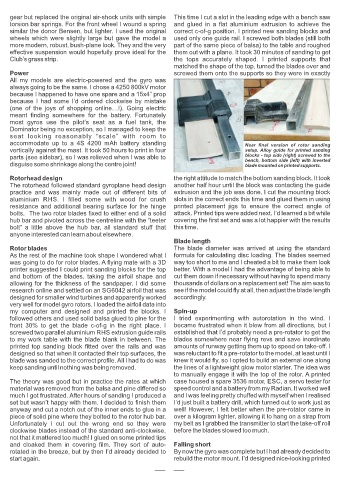
    accommodate  up  to  a  4S  4200  mAh  battery  standing                           Near  final  version  of  rotor  sanding
    vertically against the mast. It took 50 hours to print in four                     setup. Alloy guide for printed sanding
    parts (see sidebar), so I was relieved when I was able to                          blocks - top side (right) screwed to the
                                                                                       bench, bottom side (left) with inverted
    disguise some shrinkage along the centre joint!                                    blade mounted on printed supports.
    Rotorhead design                                          the right attitude to match the bottom sanding block. It took
    The rotorhead followed standard gyroplane head design  another half hour until the block was contacting the guide
    practice  and  was  mainly  made  out  of  different  bits  of  extrusion and the job was done. I cut the mounting block
    aluminium  RHS.  I  filled  some  with  wood  for  crush  slots in the correct ends this time and glued them in using
    resistance and additional bearing surface for the hinge  printed  placement  jigs  to  ensure  the  correct  angle  of
    bolts.  The two rotor blades fixed to either end of a solid  attack. Printed tips were added next. I’d learned a bit while
    hub bar and pivoted across the centreline with the “teeter  covering the first set and was a lot happier with the results
    bolt”  a  little  above  the  hub  bar,  all  standard  stuff  that  this time.
    anyone interested can learn about elsewhere.
                                                              Blade length
    Rotor blades                                              The  blade  diameter  was  arrived  at  using  the  standard
    As the rest of the machine took shape I wondered what I  formula for calculating disc loading. The blades seemed
    was going to do for rotor blades. A flying mate with a 3D  way too short to me and I cheated a bit to make them look
    printer suggested I could print sanding blocks for the top  better. With a model I had the advantage of being able to
    and  bottom  of  the  blades,  taking  the  airfoil  shape  and  cut them down if necessary without having to spend many
    allowing for the thickness of the sandpaper. I did some  thousands of dollars on a replacement set! The aim was to
    research online and settled on an SG6042 airfoil that was  see if the model could fly at all, then adjust the blade length
    designed for smaller wind turbines and apparently worked  accordingly.
    very well for model gyro rotors. I loaded the airfoil data into
    my  computer  and  designed  and  printed  the  blocks.  I  Spin-up
    followed others and used solid balsa glued to pine for the  I  tried  experimenting  with  autorotation  in  the  wind.  I
    front  30%  to  get  the  blade  c-of-g  in  the  right  place.  I  became frustrated when it blew from all directions, but I
    screwed two parallel aluminium RHS extrusion guide rails  established that I’d probably need a pre-rotator to get the
    to my work table with the blade blank in between. The  blades somewhere near flying revs and save inordinate
    printed  top  sanding  block  fitted  over  the  rails  and  was  amounts of runway getting them up to speed on take-off. I
    designed so that when it contacted their top surfaces, the  was reluctant to fit a pre-rotator to the model, at least until I
    blade was sanded to the correct profile. All I had to do was  knew it would fly, so I opted to build an external one along
    keep sanding until nothing was being removed.             the lines of a lightweight glow motor starter. The idea was
                                                              to manually engage it with the top of the rotor. A printed
    The theory was good but in practice the rates at which  case housed a spare 3536 motor, ESC, a servo tester for
    material was removed from the balsa and pine differed so  speed control and a battery from my Radian. It worked well
    much I got frustrated. After hours of sanding I produced a  and I was feeling pretty chuffed with myself when I realised
    set but wasn’t happy with them. I decided to finish them  I’d just built a battery drill, which turned out to work just as
    anyway and cut a notch out of the inner ends to glue in a  well! However, I felt better when the pre-rotator came in
    piece of solid pine where they bolted to the rotor hub bar.  over a kilogram lighter, allowing it to hang on a strap from
    Unfortunately  I  cut  out  the  wrong  end  so  they  were  my belt as I grabbed the transmitter to start the take-off roll
    clockwise blades instead of the standard anti-clockwise,  before the blades slowed too much.
    not that it mattered too much! I glued on some printed tips
    and  cloaked  them  in  covering  film.  They  sort  of  auto-  Falling short
    rotated in the breeze, but by then I’d already decided to  By now the gyro was complete but I had already decided to
    start again.                                              rebuild the motor mount. I’d designed nice-looking printed
                                                           10

