


Page 36 - MFW June 2025
P. 36
GPS TRIANGLE RACING NATIONALS


     Dave & Kev
     Dave & Kev
     Dave & Kev


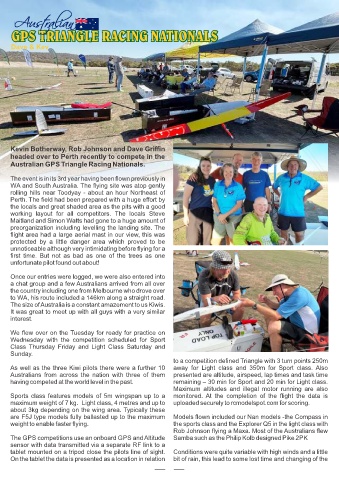
     Kevin Botherway, Rob Johnson and Dave Griffin
     headed over to Perth recently to compete in the
     Australian GPS Triangle Racing Nationals.

     The event is in its 3rd year having been flown previously in
     WA and South Australia. The flying site was atop gently
     rolling hills near Toodyay - about an hour Northeast of
     Perth. The field had been prepared with a huge effort by
     the locals and great shaded area as the pits with a good
     working  layout  for  all  competitors.  The  locals  Steve
     Maitland and Simon Watts had gone to a huge amount of
     preorganization including levelling the landing site. The
     flight area had a large aerial mast in our view, this was
     protected  by  a  little  danger  area  which  proved  to  be
     unnoticeable although very intimidating before flying for a
     first  time.  But  not  as  bad  as  one  of  the  trees  as  one
     unfortunate pilot found out about!

     Once our entries were logged, we were also entered into
     a chat group and a few Australians arrived from all over
     the country including one from Melbourne who drove over
     to WA, his route included a 146km along a straight road.
     The size of Australia is a constant amazement to us Kiwis.
     It was great to meet up with all guys with a very similar
     interest.

     We flew over on the Tuesday for ready for practice on
     Wednesday  with  the  competition  scheduled  for  Sport
     Class  Thursday  Friday  and  Light  Class  Saturday  and
     Sunday.
                                                              to a competition defined Triangle with 3 turn points 250m
     As well as the three Kiwi pilots there were a further 10   away  for  Light  class  and  350m  for  Sport  class.  Also
     Australians  from  across  the  nation  with  three  of  them   presented are altitude, airspeed, lap times and task time
     having competed at the world level in the past.          remaining – 30 min for Sport and 20 min for Light class.
                                                              Maximum  altitudes  and  illegal  motor  running  are  also
     Sports class features models of 5m wingspan up to a      monitored.  At  the  completion  of  the  flight  the  data  is
     maximum weight of 7 kg.  Light class, 4 metres and up to   uploaded securely to rcmodelspot.com for scoring.
     about 3kg depending on the wing area. Typically these
     are F5J type models fully ballasted up to the maximum    Models flown included our Nan models -the Compass in
     weight to enable faster flying.                           the sports class and the Explorer Q5 in the light class with
                                                              Rob Johnson flying a Maxa. Most of the Australians flew
     The GPS competitions use an onboard GPS and Altitude     Samba such as the Philip Kolb designed Pike 2PK
     sensor with data transmitted via a separate RF link to a
     tablet mounted on a tripod close the pilots line of sight.   Conditions were quite variable with high winds and a little
     On the tablet the data is presented as a location in relation   bit of rain, this lead to some lost time and changing of the
                                                           35

