


Page 19 - MFW June 2024
P. 19
check and run the engine. The engine had not been run in  On a personal note I would like to thank everyone for their
    the plane before so we made sure it was well tied down,  help and encouragement during the whole journey, and I
    and Russell bravely held onto the tail. The engine needs  look forward to more flights in the new year.
    priming with fuel and then it generally starts very easily.  Regards,   Phil Sharp.
    Once we got a bit of fuel in it away it went. It takes a little bit
    of running to clear all the oil, but will then idle at about 900  Post Script.   Phil and John have now had four flights to
    RPM.  Max  speed  is  2500  RPM  which  produces  60lbs  date getting to know the model and its eccentricity better
    thrust, more than enough. I have fitted an optical RPM  each  time.  The  gyroscopic  effect  from  the  motor  does
    sensor, but they don’t work that well in bright sunlight. We  make it’s presence felt on occasions and John is dealing
    ran the engine for a while and it seemed OK so John said  well with that but on the third flight  the drama came when
    let’s try a taxi run, and maybe take off. So out on the strip  on landing approach John had to apply a little throttle,
    we fired it up, poor Russell hanging on again, and then let it  unfortunately  the  engine  responded  too  much,  which
    settle back to idle, fortunately at idle it doesn’t pull too  resulted in a massive torque roll. I guess we all thought it
    much.                                                     was all over, but magic reaction from John saved the day.
    John advanced the throttle and it started rolling, then the  A couple more circuits to calm the nerves and the second
    engine kicked in, and in 15m or so it was in the air, with a  attempt was fine.
    little bit of left roll. I must admit my memory is a little vague,
    but it climbed well.  The real problem is getting the engine  The problem with the engine control is difficult because it
    to  a  smooth  running  RPM.John  turned  right  and  the  relies solely on fuel supply. Anything other than full power
    gyroscopic effect meant the nose dropped which took a  means a rich mixture. The other issue is that I am using a
    while to recover from, but with more throttle John gained  small pump from a jet turbine, and I was running it at a low
    some good height to get a bit of a feel for it. Aileron control  voltage to reduce the flow. This proved too difficult to get
    was good, and pitch OK, although he switched to high  enough control, so I have now fitted a bypass valve, which
    rates. After a couple of circuits a landing approach was  bypasses about 50% back to the tank. This allows the
    made, but by this time the wind was starting to blow across  pump to run in a better voltage range and has made a
    the strip, which meant a go around. With a reasonable  considerable improvement to the low speed running and
    amount of throttle it shot away, certainly no lack of power.  softened the response. The fourth flight was much less
    Another approach, the wind still pushing it towards the  nerve  wracking! The two video  clips  will  show  that the
    fence, but this time a successful landing. I was very happy  throttle control is much better.
    and relieved! John did a fantastic job, I can’t thank him   Some video links of a days flying are available here on the club facebook page;....................
    enough. His words were “it’s a beast”. Hopefully we can
    tame it a bit in the next few flights.                     https://www.facebook.com/1143093532/videos/780069180276887/?idorvanity=300601920024462
                                                              https://www.facebook.com/1143093532/videos/377095651905992/?idorvanity=300601920024462
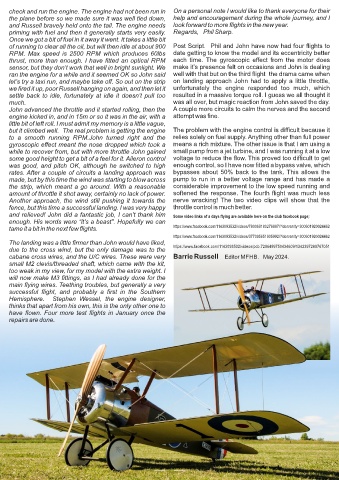
    The landing was a little firmer than John would have liked,
                                                              https://www.facebook.com/1143093532/videos/pcb.7296499750434609/1342397289767051
    due to the cross wind, but the only damage was to the
    cabane cross wires, and the U/C wires. These were very  Barrie Russell    Editor MFHB.   May 2024.
    small M2 clevis/threaded shaft, which came with the kit,
    too weak in my view, for my model with the extra weight. I
    will now make M3 fittings, as I had already done for the
    main flying wires. Teething troubles, but generally a very
    successful  flight,  and  probably  a  first  in  the  Southern
    Hemisphere.    Stephen  Wessel,  the  engine  designer,
    thinks that apart from his own, this is the only other one to
    have flown. Four more test flights in January once the
    repairs are done.


                                                            18

