

Control Line – Flying with strings (wires) attached.
In Control line flying, the pilot stands in the centre of the flight circle and the model flies around him (or her), restrained by two lines running from a control handle through the inboard wing of the model and connected to its elevator, thus controlling pitch and height.
The model thus flies in a half hemisphere around the pilot, who must have good reflexes and skill to avoid hitting the ground which is never more than 22m away. This is particularly important in precision aerobatics when a schedule of tricky manoeuvres are performed.
The pilot feels the pull of the model on the handle and the need for direct and physical control means that continous movement and turning to follow it, is essential.
Models are powered by either IC engines or electric motors and the lines are steel or special high strength polyethylene.
An active group of NZ modellers regularly experience the delights, challenges and excitement of control line flying in a number of disciplines:
Precision aerobatics or stunt. Four classes for beginners through to international FAI level.
Team racing A number of classes catering for all levels of skill and complexity up to international FAI grade. Up to three pilots in the same circle at once, race over a fixed number of laps. Each has a pit crew for refuelling and restarting the engine.
Combat What it sounds like! Two pilots fly against each other in the same circle at the same time and try to cut the opponents streamer to win the bout. Two classes, a NZ slow class and the international FAI class.
Scale Three classes, profile, general and FAI. RC operation of special features is allowed.
A video link showing typical aerobatic control line model flying is here:
Introduction to Control Line Flying – YouTube https://www.youtube.com/watch?v=P4rqILAs_xo
Here is the same modeller with an explanation of CL flying: Control Line Airplane Flying Explanation
If you can stand the American way of presenting a movie, here is an American AMA film of CL flying showing all the various disciplines. AMA Wired for excitement
Speed Highly developed propeller and pulse jet powered models are flown.
General sport flying. Most control line enthusiasts fly with the intention of developing their models and skill for competition, however many fly just for the fun of it, and all CL flying provides the thrill of feeling the model in flight and satisfaction of a safe landing at the end!

An aerobatics contestant with the judge in the background.
P51D semi scale model

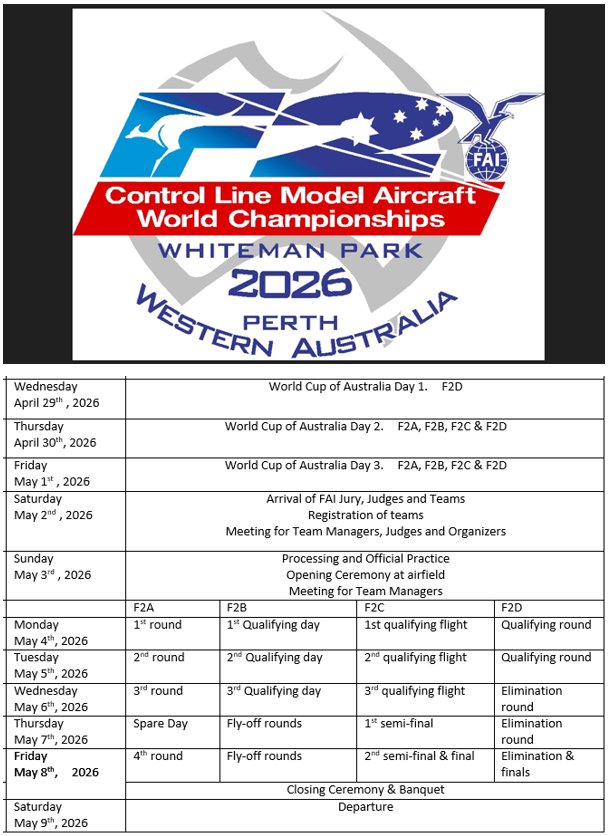
2026 Control line World Champs at Perth, Australia.
The 2026 NZ team are:
Control Line Event Calendar for 2025/26.
2026
R4 – 1st-8th January – Nationals (Waipukurau)
R5 – 31st January-1st February – Waikato Grass Champs (HMAC/Meremere)
T2 – 20-22nd February – Waikato Tarmac Champs (HMAC/NPMAC)
R6 – 7th-8th March (Taranaki Anniversary Weekend) – Whangarei Champs (WRMAC)
R7 – 3rd-5th April (Easter) – Taranaki Easter Champs (NPMAC)
W2 – 29th April-1st May – CL World Cup (Perth, Australia)
W3 – 3rd-8th May – CL World Champs (Perth, Australia)
R8 – 30th May (King’s Birthday) – Southern Champs (Christchurch MAC)
C4 – 20th June (Winter Solstice) – Shortest Day Combat (NOCLASS)
NDC info (to be confirmed):
Aug 25 – All TR & Speed
Oct 25 – All TR & Speed (Spring Champs)
Feb 26 – Speed & TR (Waikato Champs)
Apr 26 – All TR & Speed (Easter)
Key:
R = Round of the Stunt Series (+ other things like scale or grass racing)
T = Tarmac speed and racing
C = Combat
F = Fun fly
W = World Champs
With Winter upon us, again we come to the end of the Stunt Series and crown our champion for the 2023-2024 season. Congratulations to Kevin Barnes!
Kevin has held on to both the first and second spots overall by topping the tables in the F2B and Classic categories. A great launch pad for his upcoming adventure as our sole F2B representative at the CL world Champs in Muncie, USA in August. Well done and good luck in America! On that note, good luck also to the rest of the team going into battle in F2C and F2D.
As has become quite common in the Stunt Series, final placings are decided by remarkably narrow margins, often split by bonus points and in this case a countback. Only four points separate Kevin and our third and fourth place-getters. Between third and fourth, equal on maximum round points, equal on bonus points… it’s only a superior fourth round countback that gives Chris Chambers the edge to hold third place with his Sportsman-leading results over Owen Rogers’ Classic Stunt performances. Well done guys – you’ve kept things interesting right up to the end.
Similarly fourth and fifth have been decided by bonus points with Chris Renton’s greater number of victims in Sportsman being enough to only just surpass Roscoe Smith’s string of Intermediate-leading maxes by 0.7 points out of 3003 – a margin of just 0.023%
Top job, everyone! It’s been a very successful and enjoyable contest.
Many thanks to all involved in producing such a great season of stunt flying – in particular our numerous judges throughout the year and the country led by Karen Barnes with frequent contributions by Don Robinson, Alina Wimmer, Gus Knapp, John Carrodus, Alan Lawrence and numerous other helpers, movers and shakers. Special thanks to Chris Chambers for stepping up to take on a big chunk of the Stunt Series admin. We greatly appreciate the time and expertise you all offer that allows these contests to take place.
Stay busy this winter and warm yourselves with aeromodelling in all its forms. Next up on the calendar is the 26th Shortest Day combat meeting at JR Airsail in Pukekawa in a few weeks. In August the NZL team jet off in pursuit of glory at the CL World Champs in the USA. Best of luck, team!
Stunt Series Coordinator
 2024 Control Line World Champs (for interest sake)
Control Line AGM 2026 Documents
This is the remit which covers
- Classic Team Racing – Props
- Slow Combat – Speed
View the full remit here
Links & Contacts